[email protected] +92-51-884-0600

Bachelor of Dental Surgery (BDS)

Overview of BDS Curriculum

Shifa College of Dentistry (SCD) curriculum instils the enduring qualities essential for clinical excellence in dental practice, while also including essential emerging competencies such as an understanding of community oral health, health care ethics, and patient safety in the dental practitioners of tomorrow. The SCD curriculum is a blend of system-based and competency-based approaches and is integrated horizontally and vertically, following the syllabus and guidelines laid by PM&DC. It has been developed taking into consideration cognitivist, behaviourist, and some elements of a constructivist approach. It allows students to construct their own knowledge based on what they already know and to use that knowledge in activities which require critical thinking and problem solving. Conscious efforts have been made to ensure that students develop a holistic approach towards the management and treatment of oral diseases. Specially designed longitudinal threads run throughout the curriculum to ensure that effective schema development takes place in the minds of our students.

Program Learning Outcomes of BDS (PLOs)

The program learning outcomes (PLOs) of the BDS program signify the expected level of professional achievement from a dental graduate of the Shifa College of Dentistry, upon completion of their BDS degree. These are termed as Program Learning Outcomes (PLOs) and are listed below:

  1. Apply and integrate the relevant knowledge, skills, and attitudes of basic sciences with clinical dental practice.
  2. Plan a holistic approach for the diagnosis of oral diseases and systemic diseases with oral manifestations through effective history taking, data recording, and interpretation of clinical findings.
  3. Independently manage common, non-critical dental problems at an appropriate level of competence for a general dental practitioner.
  4. Practice safely and effectively, making the high-quality long-term care of patients the first concern.
  5. Apply the principles of oral health promotion and disease prevention through outreach programs with emphasis on prevalent diseases in the population.
  6. Demonstrate continuing professionalism through their education, training and practice and maintain high standards of ethics and conduct in all aspects of professional life.
  7. Effectively communicate and collaborate with dental team members, patients, and their families to deliver better patient outcomes.
  8. Describe and practice the principles of good research related to all aspects of oral health and interpret it for application as part of an evidence-based approach to clinical judgment, decision-making, and problem-solving skills in relation to oral health.
  9. Demonstrate effective clinical decision making, accurately assess their own capabilities and limitations, demonstrating reflective practice, in the interest of high-quality patient care and act within these boundaries.
  10. Manifest the attributes of lifelong learning and recognize its importance and apply it to practice.
  11. Employ critical thinking, creativity, and innovations in dental practice.

Organization of Curriculum

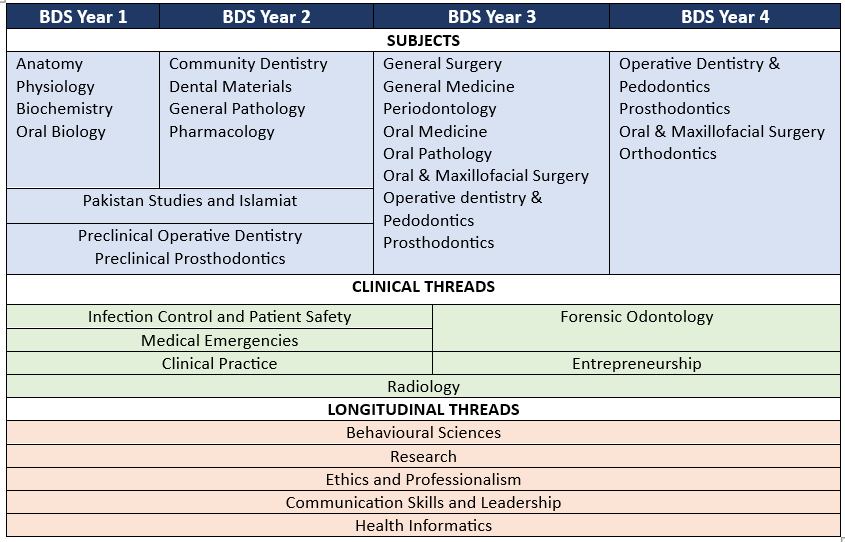
The SCD curriculum is a blend of system-based and competency-based approaches. The curriculum is organized as an integrated modular curriculum spanning over four calendar years. Each academic year is further divided into two teaching blocks. Blocks are composed of system-based modules in the initial years and disease-based modules in the clinical years. These modules have further been subdivided into symptom/ clinical case-based themes as per requirement. Specific longitudinal threads run throughout the four-year curriculum as integrated elements for horizontal and vertical integration. The longitudinal threads comprise essential subjects including Pakistan Studies, Islamiyat and Behavioural Sciences along with specifically designed clinical threads that facilitate students’ transition from basic to clinical years.

  • Year I

The two teaching blocks in year I are further divided into smaller modules which focus on the basis of normal structure, function, and biochemical aspects of the human body and oral cavity in the clinical context.

  • Year II

Year II is also organized in a similar fashion with modules focusing on abnormalities occurring in the structure and function of the human body along with the basics for therapeutic treatments. This spiral also introduces students to dental public health, and preventive dentistry along with the science of dental materials. Preclinical Sciences of Operative and Prosthodontics also run longitudinally throughout the year.

  • Year III

Year III marks the beginning of formal clinical training for the students with exposure to general medical sciences, along with specific dental sciences with dedicated clinical rotations. The clinical exposure in Year III serves as a foundation for holistic dental practice.

  • Year IV

Year IV focuses on comprehensive dental care with the integration of clinical dental sciences. The focus of this spiral is to ensure that the students reach the desired level of competence needed for a general dental practitioner. To achieve this, students are required to spend the maximum time of the year in clinical rotations.

The following diagram represents placement of all the subjects and the longitudinal threads in the SCD curriculum which are delivered in the form on integrated modules and block wise clinical rotations for clinical dental sciences.

Modules:

Each module is further divided into themes which integrate multiple disciplines. Each module has its Module Learning Outcomes (MLOs) targeting the cognitive, psychomotor and affective domains, and is developed in line with the Program Learning Outcomes (PLOs) of the BDS Program. The content of the module is reflected in the modular study guide.

Assessments:

There are broadly two types of examinations at SCD. These include the professional examinations conducted by the Shifa Tameer e Millat University and internal examinations conducted by the college.

The internal and external examinations consist of theory and practical components. Each modular unit is followed by an end-of-module theory examination, whereas skills are assessed in an end-of-block practical/ clinical examination. These internal examinations carry 40% weightage in the final assessment of a student, whereas 60% belongs to the professional examination.

In clinical years, students are assessed through competency tests. Achievement of these competencies is mandatory for all students, and they must have achieved the required number of specific competencies for each discipline before they are eligible to appear in the block examination.

Patient portfolios and logbooks are used as a means of continuous assessment and carry weightage in the internal assessments.

Progression and duration of BDS program

The students enrolled in the BDS program are expected to complete their academic and administrative requirements within 4 years of the program. The progression from one academic year to the next is dependent on the completion of minimum attendance (90%) and a prerequisite performance criterion. The completion of the degree program is marked by the fulfilment of all academic and administrative requirements on part of the student